Exercise Physiologist or Personal Trainer: Which One Under the NDIS?
An exercise physiologist is a university-qualified allied health professional who designs exercise for health conditions and disability, and the NDIS funds their work as therapy. A personal trainer has a Certificate III, IV or Diploma in Fitness, and the NDIS can fund personal training under improved health and wellbeing, but not as therapy. Many people start with an exercise physiologist.
How Do They Compare?
Different training, different funding rules and different price limits.
| Exercise physiologist | Personal trainer | |
|---|---|---|
| Training | At least a four-year ESSA-accredited degree plus clinical practice | Certificate III, IV or Diploma in Fitness, or equivalent |
| NDIS rule | Must be an Accredited Exercise Physiologist with ESSA | Must hold a personal training qualification |
| Treated as therapy by the NDIS? | Yes | No |
| Price limit, most of Australia | $161.99 an hour | $69.39 an hour |
| Travel | Claimable at up to half the hourly limit | Not a therapy provider, so the therapy travel rule doesn't apply |
When Does an Exercise Physiologist Make More Sense?
When there's a health condition, pain, a risk of falls or an injury to work around.
Exercise physiologists assess physical condition, symptoms and health history, then build a program that's safe for that person. ESSA says they work with people with chronic conditions, injuries and disabilities. If you're starting out, have a complex health picture, or need evidence for your plan, an exercise physiologist is usually the place to start.
Looking for an Exercise Physiologist?
We'll connect you with a practice with accredited exercise physiologists that may have space.
When Might a Personal Trainer Fit?
To keep going with a program once it's safely set up, if your plan funds it.
The NDIS says improved health and wellbeing funding can include a personal trainer to help you exercise safely and effectively. It also says personal training can't be funded as therapy. If your plan has funding for it, some people use an exercise physiologist to design the program and a personal trainer for regular sessions. Check with your plan manager or support coordinator first.
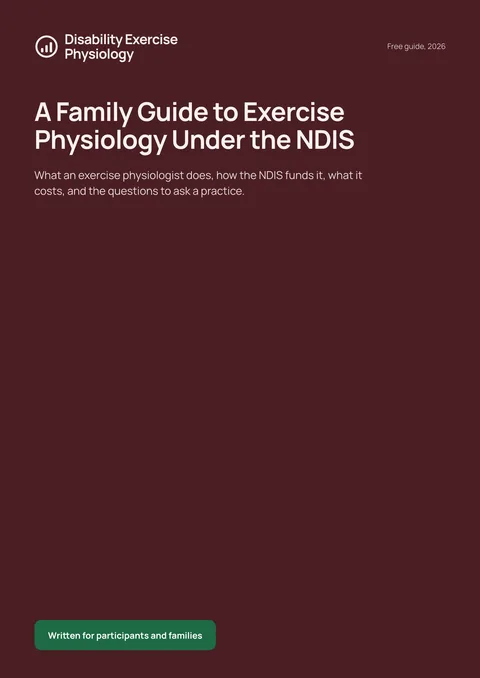
Free Family Guide
Free PDF, sent to your inbox.
Questions People Ask
Does the NDIS fund personal trainers?
It can, under improved health and wellbeing, to help you exercise safely. Personal training isn't funded as a therapy support.
Is an exercise physiologist better than a personal trainer?
Not better, different. An exercise physiologist is qualified to work with health conditions and disability. A personal trainer is a fitness professional. Which suits depends on your goals and health.
Why is an exercise physiologist more expensive?
The NDIS price limit is higher ($161.99 against $69.39 an hour in most of Australia) because they're university-qualified allied health professionals delivering therapy.
Can I use both?
Yes, if your plan funds both. Agree who does what so the program stays consistent.
Keep Reading
- What is an exercise physiologist?What an accredited exercise physiologist is, their training, what they do for people with disability, where they work, and how they fit with the NDIS.
- Gym and pool sessionsExercise physiology sessions in a gym or pool under the NDIS: what can be funded, why memberships and entry fees aren't, and how to make a program work.
- Exercise physiology and the NDISHow the NDIS funds exercise physiology: the capacity building categories it sits in, who can deliver it, what it can't pay for, and plan management rules.
- Exercise physiologist or physio?The difference between an exercise physiologist and a physiotherapist: training, regulation, what each does, NDIS price limits, and when to see which one.
We share your details with one provider at a time, never a list. Privacy policy